Armstrong Bridge
Leaving the well, we re-trace our steps to Jesmond Dene Road and walk south towards Armstrong Bridge passing on our left side the site of Stotes Hall. Stotes Hall, regretfully demolished some years ago, dated back to the 17th Century and was originally a stone-built house, one of the many erected for the yoemen of the North of England during the reigns of the late Tudors and early Stuarts. In 1607 it was rebuilt and again, in the 19th Century, it was modernised and later altered until it stood three storeys high. The house, prior to demolition, showed both Tudor and Jacobean influences. The house in the 16th Century stood on what were called the Gibson lands, and in 1658 Sir Richard Stote bought the land from Sir Francis Anderson; from that time the house became known as Stote Hall. The old house was reputed to have been a resting place for Oliver Cromwell on one of his visits to the area, but it is best known for having housed a school opened in 1760 by Dr Charles Hutton, a great mathematician.
From Stotes Hall we descend back into the Dene by Cherry walk and crossing the wooden footbridge we pass through Pets’ Corner with its display of foreign birds and animals, a delight to children for many years, and arrive at Millfield House. Originally a flourmill, parts of the house are at least 100 years old and the mill race which carried water to the mill can still be traced along the side of Red Walk in the Dene. The last occupant of the house dug up in the extensive gardens at different times, a coin of 1777 and a workman’s token of the same date. The house is reputedly haunted by the ghost of a murdered serving maid which has been seen on several occasions. The ghost has caused no alarm and is affectionately called Elvira.

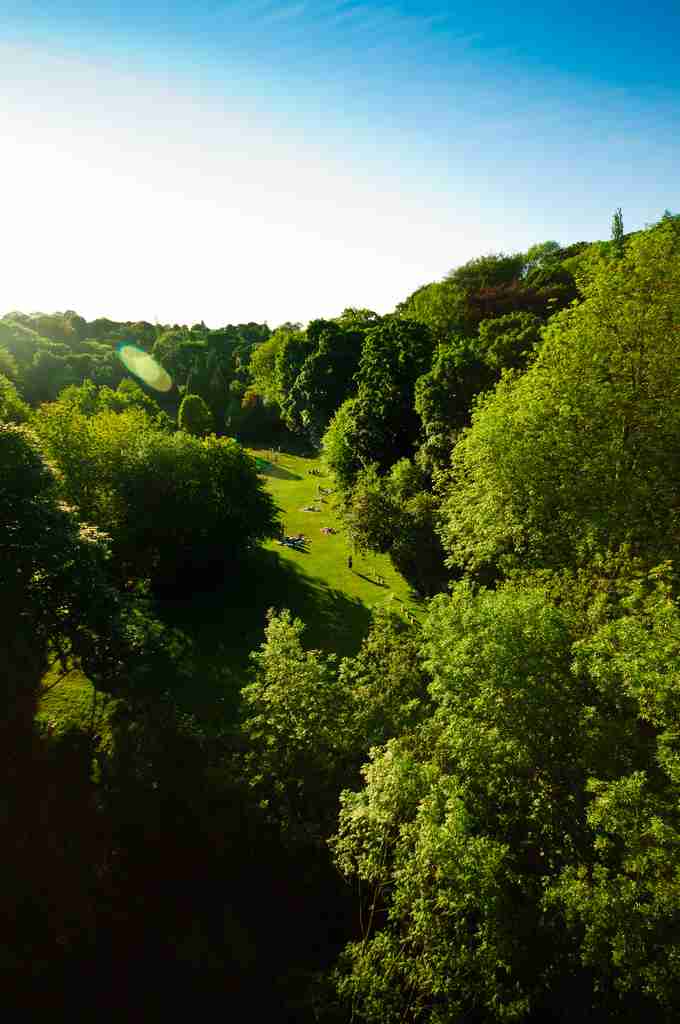
Armstrong Bridge is a landmark held in high esteem and affectionate regard by the citizens of the city. It is a listed structure and care is taken to maintain the original character of the bridge. Recently, the west abutment has been stabilised and tapered but it remains open to cyclists and pedestrians.
Colemans Field
Adjoining Pets’ Corner is a pleasant grassed area known as Coleman’s field, once the site of Coleman’s farm. From here we get a magnificent view of Armstrong Bridge spanning the Ouseburn valley. The bridge was presented to the citizens of Newcastle by Sir William George Armstrong and opened on 30th April 1878. The contractors for the masonry were Messrs. W E & F Jackson. It is a lattice girder bridge, 550 feet in length with a 25 foot carriageway. Varying in height from 30 to 65 feet, it is supported on seven columns 70 feet apart – each end of the bridge rested on massive masonry abutments and, despite its solid construction, presents a light and ornamental appearance.